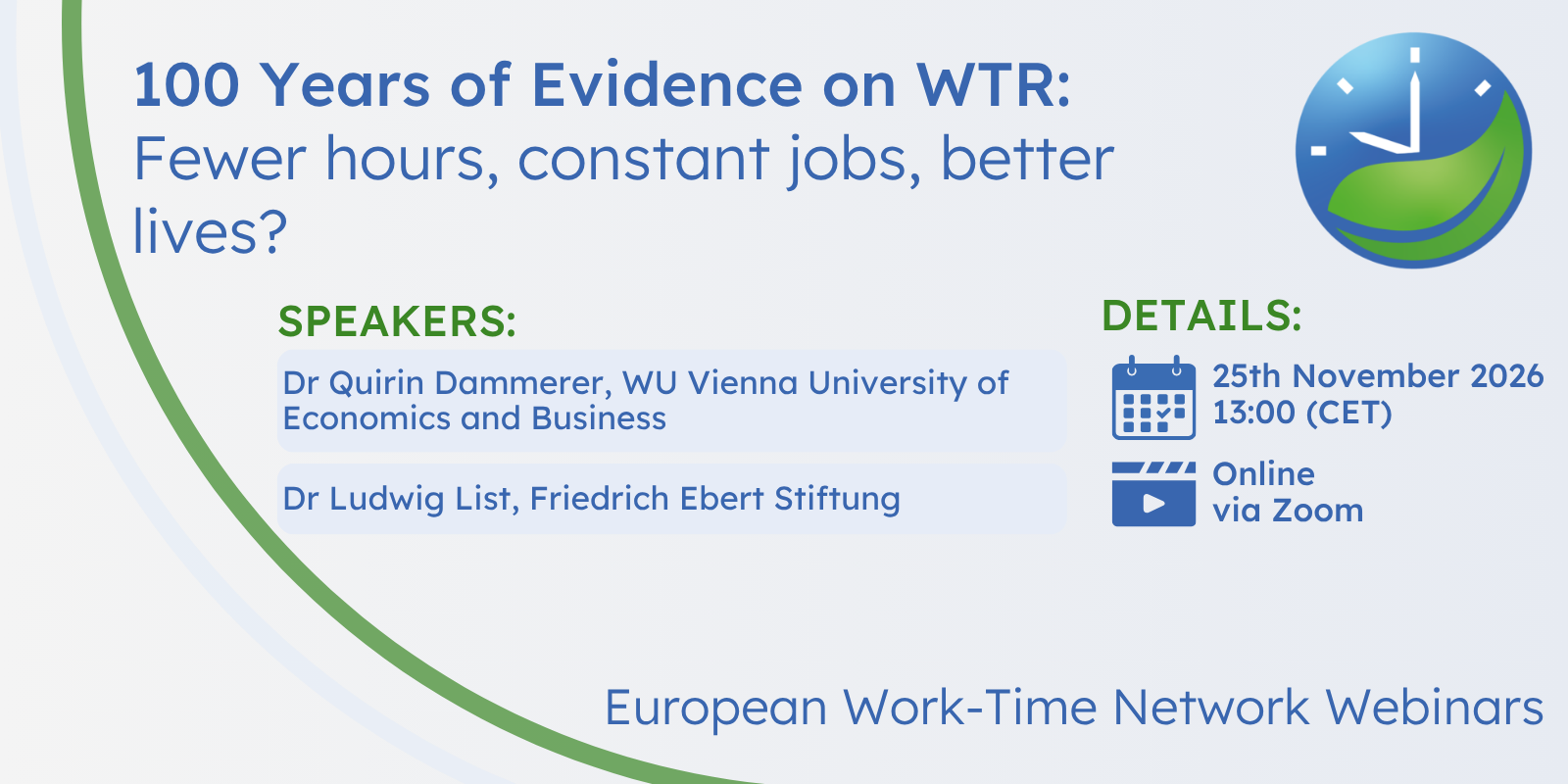
Responsive image

100 Years of Evidence on WTR: Fewer hours, constant jobs, better lives?

25 Nov 2026 from 1 p.m. to 2 p.m.
Online - Zoom, https://us02web.zoom.us/j/85484273125?pwd=IdafzWNprZwRKqIgnhRffkq0qLjCGM.1, Belgium
European Work-Time Network

About

For this European Work-Time Network webinar, we are joined by Dr. Quirin Dammerer and Dr Ludwig List to discuss what one hundred years of evidence tells us about working time reduction.

The event will be hosted online at 1pm Brussels time on Wednesday 25th November.

Fewer hours, constant jobs, better lives? What a one hundred years of evidence tells us about working time reduction. 

They said it would destroy jobs. We checked — all 100 years of it.
 
For decades, whenever workers demanded shorter hours, the same warning followed: jobs will be destroyed. Now, for the first time, we can answer that claim with the full weight of the evidence. We have built the first comprehensive database on the economic effects of working time reduction ever assembled — 214 empirical studies, 30 countries, more than 100 years of different experiences, from the eight-hour day to the four-day week. Drawing on this database, we conducted the field's first rigorous meta-analysis of the employment effects. The result: across countries and time periods, the employment effects of shorter working weeks are small and statistically indistinguishable from zero — and the evidence shows no signs of cherry-picking. The job-destruction argument does not survive contact with the data. Historically, working time reductions were about more than jobs anyway — it was about health, work-life balance, and sharing work fairly. 
 
Dr. Quirin Dammerer is a research associate at WU Vienna University of Economics and Business. His current research examines academic and media discourses on redistributive policies, as well as shared housing arrangements in Vienna, using various quantitative and qualitative methods. He is editor-in-chief of the journal Momentum Quarterly.

Dr. Ludwig List is a Vienna-based political economist and Senior Researcher at the Friedrich Ebert Foundation (FES), where he advises FES offices worldwide on research design. His research focuses on inequality, industrial and economic policy, and meta-studies. His meta-analyses, including in the Journal of Economic Surveys, synthesise contested policy debates into usable evidence.


Our speakers will deliver a short presentation on the briefing, followed by an audience Q&A.

---

Join Zoom Meeting

https://us02web.zoom.us/j/85484273125?pwd=IdafzWNprZwRKqIgnhRffkq0qLjCGM.1

Meeting ID: 854 8427 3125
Passcode: 700034

Calendar

25 Nov 2026 from 1 p.m. to 2 p.m.

Location

Online - Zoom, https://us02web.zoom.us/j/85484273125?pwd=IdafzWNprZwRKqIgnhRffkq0qLjCGM.1, Belgium

Contact

European Work-Time Network